
Strategic savings through energy arbitrage: Why timing matters now more than ever
By Eberhardt Königk, Technical Sales Manager - Solar + Battery Design Specialist, RenEnergy UK
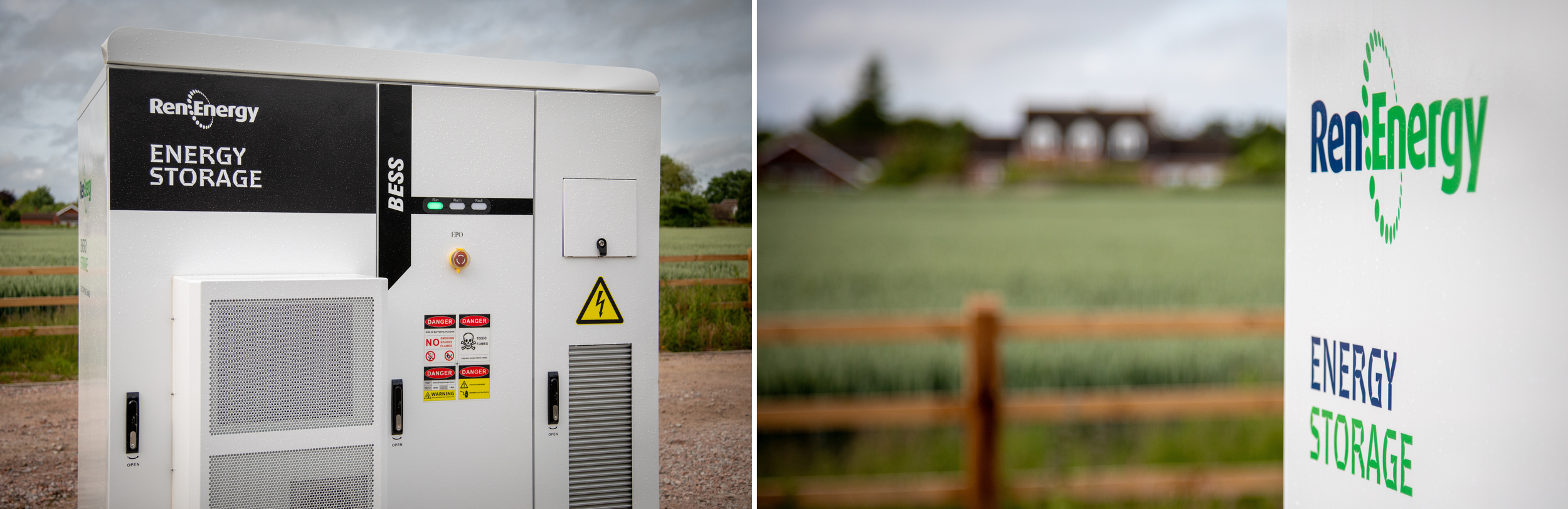
From manufacturing and food processing to logistics, data-driven operations and hospitality. Electricity is no longer a passive overhead; it is a strategic variable that can either erode margins or actively protect them.
The uncomfortable truth is that most organisations are not paying too much for electricity because they consume too much, but they are paying too much because they consume it at the worst possible time. Time-of-Use pricing, half-hourly settlement, capacity charges and volatile wholesale markets increasingly penalise when energy is used, not simply how much. For many businesses this exposure now represents a material operational and financial risk.
Whilst on-site solar has become commonplace, solar alone does not solve the problem. Without intelligent control and storage, peak-time grid exposure remains and so do peak-time costs and that is precisely why RenEnergy developed Shift + Save.
What is Shift + Save?
Shift + Save is RenEnergy’s structured approach to energy arbitrage, the deliberate capture of low-cost electricity and its use when energy is most expensive. In simple terms: store energy when it is cheap, deploy it when it is not. In the UK market, this approach delivers the greatest impact for organisations that:
Operate on half-hourly metered supplies with time-of-use or pass-through tariffs
Face high costs during peak pricing windows, including evenings, early mornings or weekends
Already have solar PV or are evaluating its installation
Expect measurable financial returns from energy infrastructure
Want control, predictability and resilience in an increasingly volatile market
Shift + Save is not about theoretical optimisation. It is about commercial realism, aligning energy consumption with price signals that already exist.
What is energy arbitrage?
Energy arbitrage is the practice of buying electricity when prices are low (off-peak) and selling or using it when prices are high (peak), typically using energy storage like batteries to profit from the price difference, balance grid supply/demand, and reduce costs for consumers. This strategy maximizes financial gains by exploiting fluctuations in energy markets driven by demand changes, renewable energy integration, and grid conditions. This is not a campaign about using less power. It is a strategy about using power on your terms.
As Eberhardt explains:
“The market is already telling businesses when electricity is cheap and when it is expensive. Shift + Save is simply about listening and then acting decisively.”
How Shift + Save works
Shift + Save combines generation, storage and control into a single operational strategy:
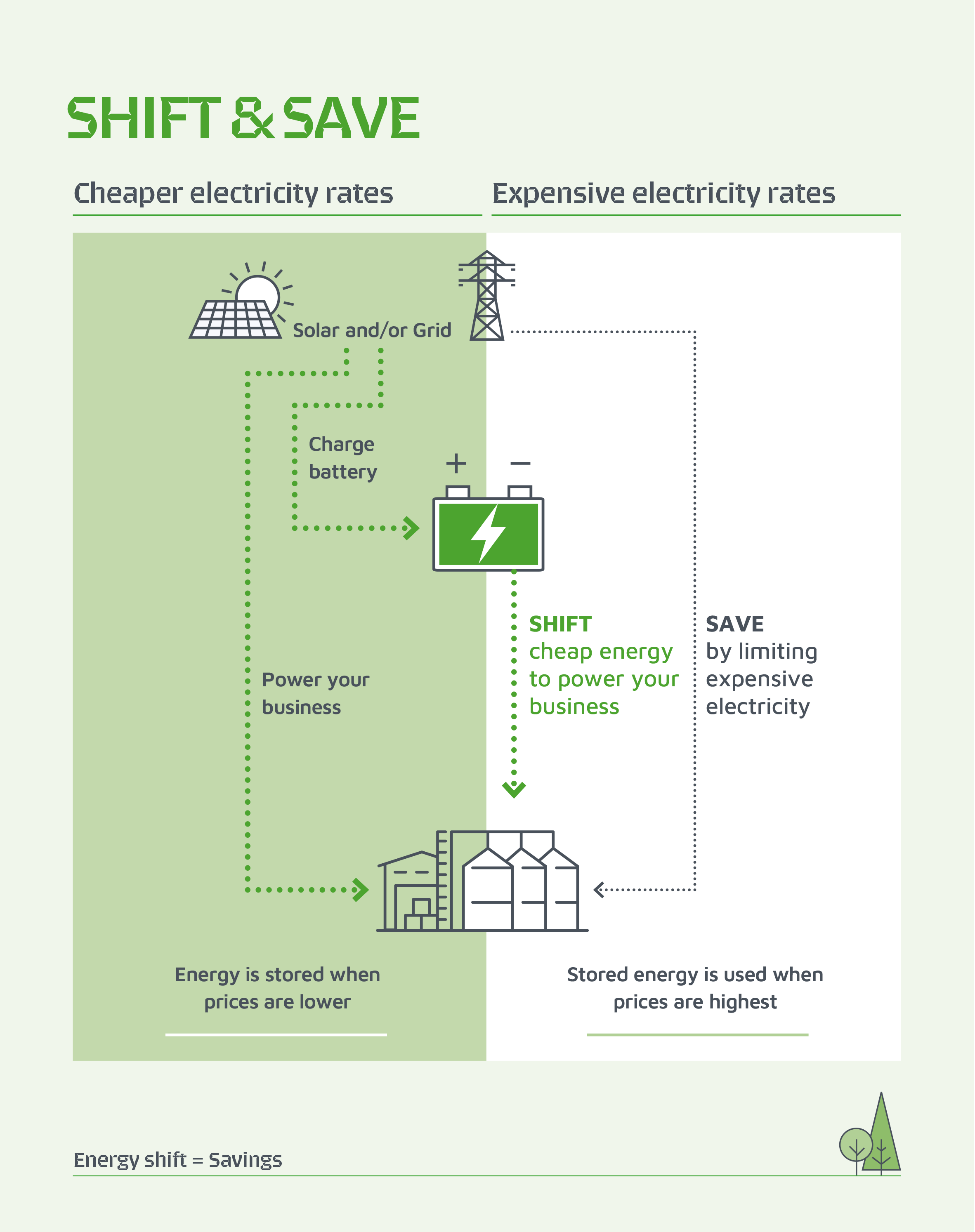
During low-cost periods, on-site solar and/or off-peak grid electricity supplies the site and charges battery storage.
During peak or high-price periods, stored energy is discharged to offset grid imports precisely when tariffs are at their highest.
The business continues operating normally but avoids paying premium rates simply to stay productive.
The outcome is not reduced output or curtailed activity. It is structural cost avoidance, engineered into daily operations.
How Shift + Save works
Shift + Save combines generation, storage and control into a single operational strategy:
During low-cost periods, on-site solar and/or off-peak grid electricity supplies the site and charges battery storage.
During peak or high-price periods, stored energy is discharged to offset grid imports precisely when tariffs are at their highest.
The business continues operating normally but avoids paying premium rates simply to stay productive.
The outcome is not reduced output or curtailed activity. It is structural cost avoidance, engineered into daily operations.
Where the savings come from
RenEnergy recently modelled a Shift + Save solution for a large hospitality operation with significant exposure to peak pricing under a half-hourly tariff.
The proposed solution combines:
Rooftop solar PV
Battery energy storage
A bespoke control strategy aligned to real tariff behaviour
The results were unambiguous, annual electricity costs were reduced substantially driven by:
A sharp decline in peak-period grid imports
A deliberate increase in consumption during lower-cost windows
Far better utilisation of on-site generation
Off-peak consumption rose marginally — and that was the point. Energy was being consumed when it was cheapest, not when it was most punitive. This example reinforces a critical reality that you do not reduce operational demand to reduce costs; you reduce the price you pay for that demand.
Arbitrage changes the investment equation
One of the most persistent objections we hear is: “Batteries are still too expensive.”
That argument is increasingly outdated. Battery costs have fallen, tariffs have risen and volatility has intensified. The spread between low-cost and high-cost electricity has widened and that spread is where arbitrage value lives. Shift + Save leverages that spread. Across multiple sectors, RenEnergy and our customers are now seeing:
Stronger internal rates of return
Payback periods typically in the four-to-six-year range
Durable long-term savings that extend well beyond asset payback
As Eberhardt puts it:
“Energy storage is no longer a resilience purchase. It is a pricing instrument. If you are not using it to control cost, you are leaving value on the table.”
Designed for performance, not panic
Too many energy storage projects are still sold as insurance policies, something you buy in anticipation of failure. At RenEnergy, we engineer systems to perform every single day, not just when something goes wrong. Our evaluations begin with:
Detailed load and demand profiling
Granular tariff and cost analysis
Dispatch and savings modelling
Full lifecycle ROI assessment
Only when the economics are proven do we specify technology. Hardware follows strategy, never the other way around. Performance is then protected through ongoing asset management, monitoring and optimisation, ensuring the system continues to deliver value as tariffs, usage patterns and market conditions evolve.
As Eberhardt states:
“The uncomfortable truth is that most businesses already have everything they need to reduce energy costs — they are just using it at the wrong time. Shift + Save brings discipline, precision and control to that reality.”
Ready to Shift + Save?
If your organisation operates on a time-of-use or flexible tariff, particularly if you already have solar or are considering it. The opportunity is immediate, RenEnergy can model your consumption, interrogate your tariff exposure and demonstrate, in financial terms, what smarter timing can achieve. In today’s energy market efficiency is not enough, timing is everything.

About Eberhardt Königk
Eberhardt Königk is the Technical Sales Manager - Solar + Battery Design Specialist at RenEnergy UK Ltd. With almost a decade of hands-on experience delivering commercial and industrial solar PV and battery energy storage solutions across the UK and Africa. He has led the design of over 1.6 GW of solar PV and 100 MWh of battery storage, supporting more than 250 successfully installed projects.
His expertise spans feasibility assessment, tariff-driven modelling, detailed system design and lifecycle cost optimisation, working closely with sales and delivery teams to ensure solutions are both technically robust and commercially sound.
With a background bridging technical sales and engineering, Eberhardt brings a pragmatic, performance-led perspective to energy strategy. At RenEnergy, his focus is on aligning energy infrastructure with real operational demand and pricing behaviour, ensuring solar and storage assets deliver measurable financial value — not just technical compliance.